
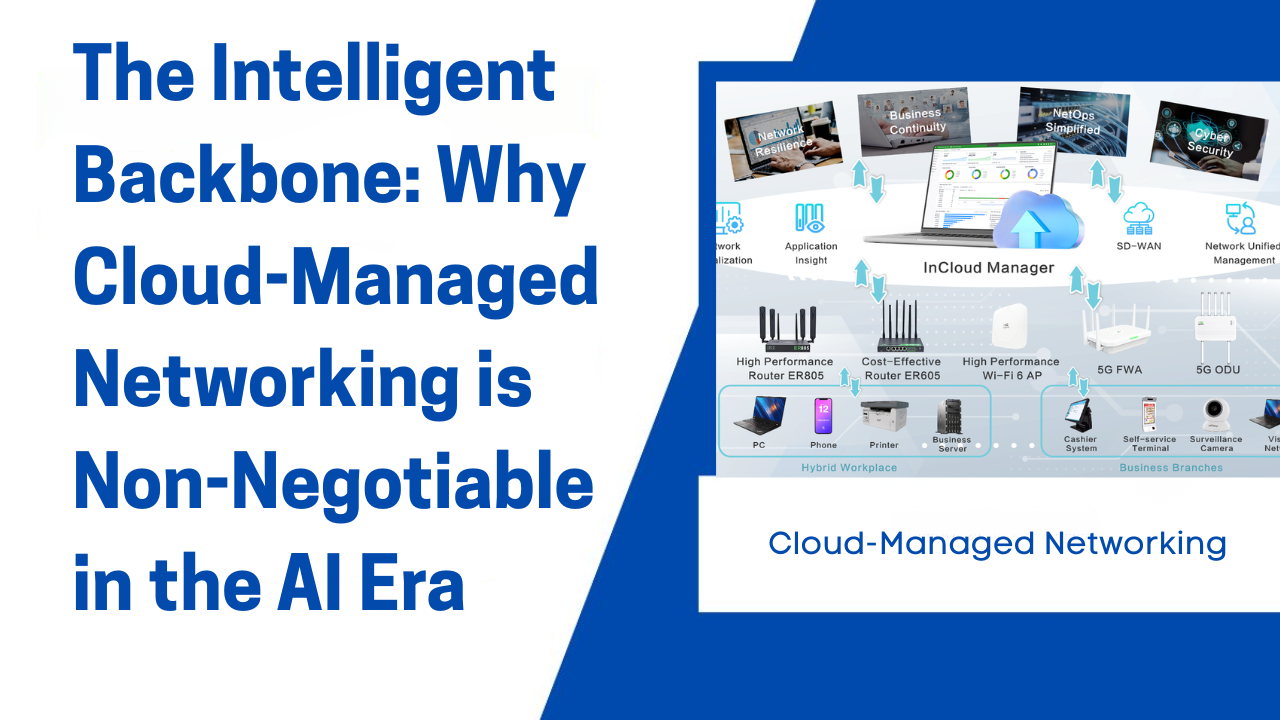
We’re living in the dawn of the AI revolution. From generative AI crafting marketing copy to predictive analytics forecasting market trends, artificial intelligence is reshaping every facet of business. But while we marvel at the outputs of large language models and machine learning algorithms, we often overlook the critical foundation that makes it all possible: the network.
The legacy way of managing networks—manually configuring each switch, router, and access point via a command-line interface (CLI)—is no longer just inefficient. In the age of AI, it’s a strategic liability. The new intelligent enterprise requires an intelligent network, and that intelligence is delivered from the cloud.
Here’s why cloud-managed network devices have become the indispensable backbone for the AI era.
1. The Scale and Agility Demands of AI Workloads
AI isn’t a static application. It involves massive data ingestion, distributed model training across GPU clusters, and real-time inference. These workloads can be incredibly “bursty,” demanding massive bandwidth one moment and less the next.
-
Traditional Network: Scaling requires ordering new hardware, manual configuration, and physical deployment—a process that takes weeks. This is a death knell for agile AI initiatives.
-
Cloud-Managed Network: Need to provision a new segment for a data science team or scale bandwidth for a model training session? With a cloud-managed solution, it’s a few clicks in a central dashboard. You can scale your network policies and resources almost as elastically as you scale your cloud compute, ensuring AI projects aren’t bottlenecked by infrastructure.
2. Proactive Intelligence, Not Reactive Firefighting
AI systems are only as good as their data, and network congestion, latency, or packet loss can poison that data. Traditional networks often operate on a “break-fix” model—you find out there’s a problem when a user or system complains.
Cloud-managed networks flip this script. They are built with telemetry and analytics at their core.
-
AI-Powered Insights: The cloud management platform itself uses AI and machine learning to analyze network data from all your global sites. It can detect anomalies, predict potential failures before they happen (e.g., an access point about to fail), and automatically optimize performance for critical AI traffic.
-
Actionable Data: Instead of sifting through logs, you get clear, actionable insights. “Video traffic from security cameras is impacting the bandwidth allocated to your data lake sync.” This allows you to proactively implement Quality of Service (QoS) policies to ensure your AI pipelines always have the priority they need.
3. Unifying the Distributed Data Universe
AI thrives on data, and that data is no longer just in your on-premises data center. It’s distributed across public clouds (AWS, Azure, Google Cloud), edge locations (retail stores, factories), and branch offices. Managing a cohesive network security and access policy across this fragmented landscape is a nightmare with traditional hardware.
A cloud-managed network provides a single pane of glass for your entire network fabric. You can define a security policy for your IoT sensors in a factory and seamlessly apply it across your organization, ensuring consistent data governance—a critical requirement for training reliable AI models.
4. Fortifying Security in an AI-Driven Threat Landscape
The AI era brings not only opportunities but also new, sophisticated threats. Adversarial AI can be used to find network vulnerabilities and automate attacks at an unprecedented scale.
Cloud-managed networks are inherently more secure and updatable:
-
Centralized Security Policy: Zero-Trust security models, which are essential for protecting sensitive AI data and models, can be implemented and enforced uniformly across all devices and locations.
-
Automated, Instant Patching: When a new threat emerges, the cloud platform can push a firmware update or security patch to every connected device globally within hours, not months. This collective immunity is something a manually managed network can never achieve.
5. Freeing Up Precious IT Talent
Your network engineers are a valuable resource. Do you want them spending their time SSH-ing into individual switches to configure VLANs, or do you want them partnering with data scientists to architect a network that accelerates time-to-insight?
Cloud-managed networking automates the mundane. It simplifies complex tasks like network segmentation, device onboarding, and troubleshooting. This empowers your IT team to shift from being network mechanics to becoming strategic enablers of business innovation.
The Bottom Line: It’s About Business Velocity
In the end, the shift to cloud-managed networking isn’t just a technology upgrade; it’s a business transformation. The AI era is defined by speed—the speed of innovation, the speed of insight, and the speed of adaptation.
A traditional network is a drag on that velocity. A cloud-managed network is an accelerator. It provides the agility, intelligence, and security required to not just support AI initiatives, but to actively fuel them.
The question is no longer if you should adopt cloud-managed networking, but how quickly you can make the transition to stay competitive in the intelligent future.
Ready to future-proof your network? Explore how cloud-managed solutions can transform your infrastructure from a cost center into a competitive advantage in the AI age. Contact us for a demo today!